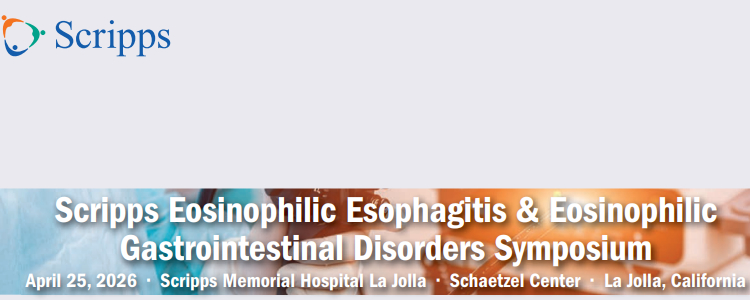
Scripps 2nd Eosinophilic Esophagitis & Eosinophilic Gastrointestinal Disorders Symposium 2026

$40.00
This Product is shared via google drive download link, So please share your correct Gmail id while placing the order .Please note that there are no CME points or certificate associated with this course Samples for Courses Can be found here : Free Samples Here!
Scripps 2nd Eosinophilic Esophagitis & Eosinophilic Gastrointestinal Disorders Symposium 2026
Comprehensive Updates in Eosinophilic Esophagitis (EoE) and Eosinophilic Gastrointestinal Disorders (EGIDs)
Scripps 2nd Eosinophilic Esophagitis & Eosinophilic Gastrointestinal Disorders Symposium 2026 is a focused educational program designed to provide healthcare professionals with the latest evidence-based advances in the diagnosis, monitoring, and treatment of eosinophilic gastrointestinal diseases. This comprehensive symposium brings together leading experts in gastroenterology, allergy and immunology, pathology, and related specialties to explore the rapidly evolving landscape of EoE and EGIDs.
The course highlights emerging diagnostic technologies, innovative therapeutic approaches, dietary management strategies, and multidisciplinary models of care that are transforming outcomes for patients affected by these chronic immune-mediated disorders.
Course Overview
Eosinophilic Esophagitis (EoE) and Eosinophilic Gastrointestinal Disorders (EGIDs) have become increasingly recognized as important causes of chronic gastrointestinal symptoms in both pediatric and adult populations. Advances in understanding disease mechanisms have led to new diagnostic tools, targeted biologic therapies, and individualized treatment approaches that are changing clinical practice.
This full-day symposium provides practical guidance for identifying patients with suspected EoE and EGIDs, establishing accurate diagnoses, implementing effective treatment strategies, and monitoring disease activity over time. Through expert-led presentations, clinical case discussions, and multidisciplinary perspectives, participants gain actionable knowledge that can be immediately integrated into patient care.
Included Content
- 15 High-Quality Video Lectures
- 15 Subtitle Files (.VTT)
- 15 PDF Presentations
- Expert Faculty Discussions
- Case-Based Clinical Reviews
- Evidence-Based Management Strategies
- Emerging Research Updates
Total Size: 1.52 GB
Key Topics Covered
Understanding Eosinophilic Gastrointestinal Disorders
Participants review:
- Eosinophilic Esophagitis (EoE)
- Eosinophilic Gastritis
- Eosinophilic Enteritis
- Eosinophilic Colitis
- Immune-mediated gastrointestinal diseases
- Pathophysiology and disease mechanisms
- Epidemiology and risk factors
Faculty discuss the current understanding of disease development and progression.
Advances in Diagnosis
Comprehensive coverage includes:
- Diagnostic criteria for EoE
- Endoscopic findings
- Histopathologic evaluation
- Biopsy interpretation
- Differential diagnosis
- Allergy assessment
- Pediatric versus adult presentations
Participants learn how to improve diagnostic accuracy and reduce delays in diagnosis.
Novel Monitoring Technologies
The symposium explores emerging tools including:
- Transnasal Endoscopy (TNE)
- EndoFlip technology
- Minimally invasive monitoring techniques
- Functional esophageal assessment
- Disease activity monitoring
- Non-endoscopic diagnostic approaches
Experts discuss how these innovations may improve long-term disease management.
Dietary Therapy for EoE and EGIDs
Sessions review:
- Elimination diets
- Six-food elimination diet (SFED)
- Targeted food elimination
- Nutritional management
- Dietitian collaboration
- Reintroduction protocols
- Long-term dietary adherence
Participants gain practical guidance for implementing dietary interventions in clinical practice.
Medical and Biologic Therapies
The course examines current and emerging treatments including:
- Proton pump inhibitors (PPIs)
- Topical corticosteroids
- Systemic therapies
- Biologic agents
- Dupilumab and targeted biologics
- Emerging small-molecule therapies
- Personalized treatment selection
Faculty discuss treatment effectiveness, safety considerations, and patient selection strategies.
Multidisciplinary Patient Care
Special emphasis is placed on collaborative management involving:
- Gastroenterologists
- Allergists and Immunologists
- Pathologists
- Radiologists
- Pediatricians
- Primary Care Physicians
- Dietitians
- Pharmacists
Participants learn how multidisciplinary care improves patient outcomes and long-term disease control.
Case-Based Clinical Management
Interactive sessions focus on:
- Challenging EoE cases
- Treatment-resistant disease
- Pediatric management strategies
- Adult disease progression
- Shared decision-making
- Individualized care plans
Real-world scenarios help reinforce practical clinical application.
Learning Objectives
Upon completion of this symposium, participants will be able to:
- Recognize clinical signs and symptoms suggestive of EoE and EGIDs.
- Apply appropriate diagnostic techniques for suspected eosinophilic gastrointestinal disease.
- Interpret endoscopic and histopathologic findings accurately.
- Utilize emerging diagnostic technologies such as TNE and EndoFlip.
- Implement evidence-based dietary and pharmacologic therapies.
- Evaluate new biologic and small-molecule treatment options.
- Incorporate the latest research findings into clinical practice.
- Develop personalized treatment plans for complex patients.
- Improve multidisciplinary collaboration in EoE and EGID management.
- Optimize patient outcomes through evidence-based care strategies.
Who Should Attend?
This program is ideal for:
- Gastroenterologists
- Allergists and Immunologists
- Pathologists
- Radiologists
- Pediatricians
- Family Practice Physicians
- Internists
- Nurse Practitioners
- Physician Assistants
- Nurses
- Pharmacists
- Gastroenterology Fellows
- Allergy Fellows
- Residents and Trainees
Why This Course Matters
The prevalence of eosinophilic gastrointestinal disorders continues to rise, while diagnostic approaches and treatment options are rapidly evolving. Scripps 2nd Eosinophilic Esophagitis & Eosinophilic Gastrointestinal Disorders Symposium 2026 delivers an up-to-date, clinically relevant review of current best practices and future directions in the field.
By combining advances in disease pathogenesis, innovative monitoring technologies, dietary interventions, biologic therapies, and multidisciplinary care models, this course equips clinicians with the knowledge needed to provide comprehensive, patient-centered care for individuals living with EoE and EGIDs.
4. Topics
-
01 Pathogenesis of EoE Are Fibrostenotic Features Reversible
-
02 Elimination Diet Therapy Should I Implement a Single-food or a Six-food Elimination Diet
-
03 First-line Medical Therapies Proton-pump Inhibitors and Topical Corticosteroids
-
04 Current State of Biologics in Treating Eosinophilic Esophagitis
-
05 Small Molecules and Emerging Therapies for Eosinophilic Esophagitis
-
06 Panel Discussion Q&A
-
07 When to Use Transnasal Endoscopy (TNE) in EoE Practical Application and Challenges
-
08 When to Use EndoFlip in EoE Practical Application and Challenges
-
09 Esophageal String Test in EoE Ready for Prime Time
-
10 The Battle of EoE Management A Case-based Debate – PPI, Steroids, Biologic, or Diet Therapy
-
11 Making the Diagnosis A Pathologist’s Perspectives in EoEEGID Histopathologic Evaluation
-
12 Role of the Allergist in EoEEGID Management
-
13 An Update on EGID Management
-
14 Case-based Review of Complex EoEEGID Patients Case
-
15 Panel Discussion Q&A
Related products