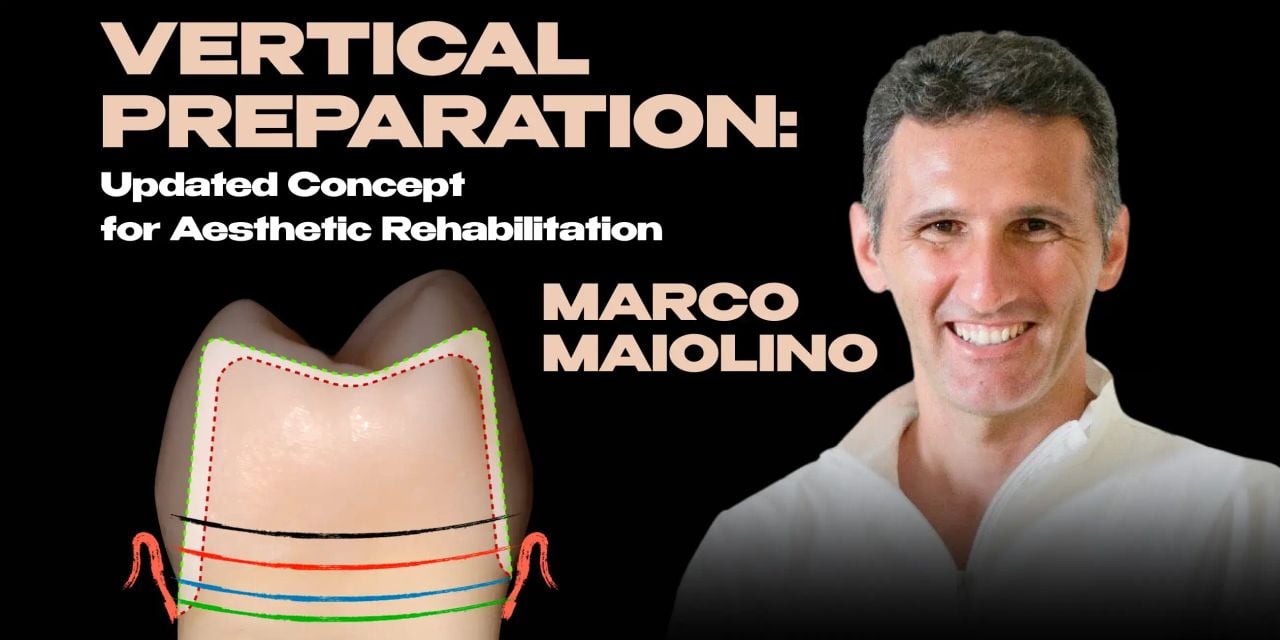
OHI-S Vertical Preparation Updated Concept for Aesthetic Rehabilitation

contain : 17 videos, size: 3.52 GB
16 lessons + 1 free (8h 44min)
Explore the precision and artistry of vertical preparation with Dr. Marco Maiolino, a Vertiprep-driven specialist!
It’s very important to approach all aesthetic cases from a prosthodontic and periodontic standpoint. The aim of indirect restorations is to achieve both healthy periodontal tissue and an aesthetic smile. With the vertical preparation technique, you will provide your patients a pink and white aesthetic and long-lasting treatment!
During this course, you will learn in detail about:
– The vertical preparation technique
– The perio-prostho and endo-prostho approach to indirect restorations
– Edge and edgeless preparation of anterior and posterior teeth
– Protocols for bonding and delivering the restoration.
Preparation techniques and clinical protocols — Everything you need to know in one big course! Join and don’t miss out!
+ Topics:
Lesson 1.Why Vertiprep?
- – Updates on the Vertiprep technique:
- – Bur protocols designed specifically for the Vertiprep technique
- – Minimal prep
- – Verticrowns
- – Lap protocols designed specifically for the Vertiprep technique.
- – Soft tissue stability with the Vertiprep approach
- – Step-by-step lab protocols to achieve biological stability with the Vertiprep technique.
Recommended for: Prosthodontists, Dental technicians, General dentists.
Lesson 2.Why not vertical?
- – The history of vertical preparation
- – Dental specialists opinion on vertical preparation then and now
- – Evolution of vertical preparation technique
- – Critical evaluation of the vertical preparation technique
- – Periodontal aspect to vertical preparation technique
- – Literature review and analysis of clinical cases.
Recommended for: Prosthodontists, Dental technicians, General dentists.
Lesson 3.The foundation of long term dentistry
- – The endo-prostho approach to a long lasting restoration
- – Treatment approach to endodontically treated teeth
- – Advantages of vertical preparation technique. Minimal invasive approach
- – Evaluation of tooth fracture risks in various clinical cases
- – Occlusal load evaluation in the vertical preparation technique
- – Compressive and tensile toughness of tooth structure and dental prosthetic restorative materials
- – Material selection for prosthetic restorations
- – The ferrule effect
- – Analysis of clinical cases.
Recommended for: Prosthodontists, Dental technicians, General dentists.
Lesson 4.Flame-shaped bur vs Batt-shaped bur. Indication, advantages and clinical application
- – Features of of the flame-shaped bur
- – Analyzing results of clinical cases using the flame-shaped bur
- – The Toe-Heel Concept. Application of the Toe-Heel concept during preparation
- – Preparation protocols using the flame-shaped bur. Evaluation of the most common mistakes
- – Steps to dealing with supragingival and subgingival undercuts
- – Indication and advantages of working the batt-shaped bur
- – Conventional approach vs edgeless preparation approach
- – When to take impressions: perfect timing
- – Step-by-step video demonstration of tooth preparation with the vertical preparation technique using a batt-shaped bur
- – Analysis of clinical cases and long-term results.
Recommended for: Prosthodontists, Dental technicians, General dentists.
Lesson 5.Tooth preparation strategies and techniques and emergence profile
- – The technique of maximum enamel saving
- – The correct bur axis when preparing the tooth
- – Excessive tapering of the restoration and how to avoid it
- – Minimal invasive preparation for maximum dentin preservation
- – Selective dentine drilling technique for anterior teeth
- – Selective dentine drilling technique for compromised teeth
- – The emergence profile consideration with vertical preparation technique.
Recommended for: Prosthodontists, Dental technicians, General dentists.
Lesson 6.The inverted shoulder approach and minimal invasive approach of tooth preparation
- – Critical biomechanical zones of the tooth
- – Evaluation of occlusal contact
- – Determination of the critical area of thickness for occlusal stability
- – Protocols of inverted shoulder preparation
- – Features of preparation, finishing the abutment and impression taking
- – Clinical cases analysis of application of inverted shoulder preparation approach.
Recommended for: Prosthodontists, Dental technicians, General dentists.
Lesson 7.Laboratory protocols of manufacturing provisional crowns
- – Analysis of common mistakes when preparing a tooth
- – How to avoid interference between the provisional crown and the tooth?
- – Analysis of common mistakes when manufacturing provisional crowns
- – A confirmed and recognized approach to provisional prosthetics. Clinical cases
- – Step-by-step Video demonstration of analogic temporary crown fabrication:
- – Fabrication protocols of posterior temporary crowns
- – Fabrication protocols of anterior temporary crowns.
- – Evaluation of tooth and soft tissue margins in relation to the temporary crowns
- – Tricks and lifehacks of provisional prosthetics
- – Analysis of clinical cases.
Recommended for: Prosthodontists, Dental technicians, General dentists.
Lesson 8.Video guide of tooth preparation and laboratory protocols of manufacturing provisional crowns
- – Video demonstration of a clinical case in an endo-prostho approach for clinical crown lengthening:
- – Full steps of an endo surgery and retrograde obturation
- – Tooth preparation protocols for a full crown restoration.
- – Step-by-step protocols for manufacturing digital provisional crowns on EXOCAD
- – Protocols of finishing and polishing of the digital provisional crown in the lab
- – Protocols of delivering the digital provisional crown to the patient
- – Protocol of in-office adjustment of the provisional crown
- – Confederation of the most common mistakes with provisional restorations
- – Mistakes when preparing teeth
- – Step-by-step prosthetic restoration of endodontically treated teeth:
- – Defining a missed canal, endo surgery and retrograde obturation
- – Healing and follow-up
- – Evaluation of the prosthetic restoration.
Recommended for: Prosthodontists, Dental technicians, General dentists.
Lesson 9.The finish line of provisional restorations. Prostho-perio considerations
- – Provisional restorations in relation to the periodontal tissue. Where to stop doing provisional restorations?
- – Guided periodontal tissue adjustment with provisional restorations
- – Adjustment of subgingival provisional crown margin
- – Analysis of clinical cases:
- – Application of the inverted shoulder approach when preparing the abutment tooth
- – Fabrication and clinical adjustment of the provisional crowns.
Recommended for: Prosthodontists, Dental technicians, General dentists.
Lesson 10.Post and core treatment approach. Is this treatment still valid? Part 1
- – Defining of the interaxial dentin
- – Occlusal force distribution on the coronal and apical part
- – Literature and clinical analysis review of the success rate and failure of crown post and core treatment approach
- – Clinical indications of fiber posts
- – Adhesion of fiber posts to the tooth tissue
- – Analysis of clinical cases:
- – Failure of fiber posts
- – Dr. Maiolino overview of fiber post restoration.
Recommended for: Prosthodontists, Dental technicians, General dentists.
Lesson 11.Post and core treatment approach. Is this treatment still valid? Part 2
- – Post and core approach to prosthetic restorations. Evaluation of treatment outcome
- – The biomechanical aspects of a post and core restoration
- – Comparing the advantages and disadvantages of metal cast posts and fiber posts
- – Step-by-step video demonstration of metal cast post placement and abutment build-up and preparation
- – Application of metal cast posts in the aesthetic zone:
- – Laboratory aspects
- – Clinical aspects.
- – Analysis of clinical cases.
Recommended for: Prosthodontists, Dental technicians, General dentists.
Lesson 12.Crown bonding. Prosthetic and die space
- – What is the true prosthetic space and why is it important?
- – Pros and cons of having a free tooth/abutment height
- – Prosthetic crown thickness: consideration in different prosthetic crown materials
- – Evaluation of the crown marginal seal and the occlusal seat in different clinical scenarios and in different tooth preparation techniques
- – Die spaces and the precementation space of a crown
- – The optimum thickness of the restoration
- – The relationship between reliability, aesthetics and long-term restoration
- – Reasons of chipping restorations at the stages of fitting and chewing
- – Geometry and biomechanics of dental preparation for indirect restorations
- – Analysis of clinical cases.
Recommended for: Prosthodontists, Dental technicians, General dentists.
Lesson 13.Analysis of prosthetic crowns structural elements. The evaluation of different applied materials
- – Literature review on the crown thickness and occlusal force load resilience
- – Classification of cracks and fractures of prosthetic crowns
- – The influence of preparation design on fracture resistance
- – The effect of reduced occlusal thickness of a crown on fracture resistance
- – Analysis of clinical cases. Follow-up on a prosthetic crown of the upper first molar.
Recommended for: Prosthodontists, Dental technicians, General dentists.
Lesson 14.Edge and edgeless preparation protocols. Impression taking protocols
- – Ideal time to take impressions
- – Advantages and indications of delayed impression
- – Advantages and indications of immediate impression
- – Edge and edgeless preparation: indications and contraindications, pros and cons
- – Detailed comparative characteristics of edge and edgeless preparation
- – Clinical case: restoration of a severely damaged tooth. Choice of preparation method.
Recommended for: Prosthodontists, Dental technicians, General dentists.
Lesson 15.Die preparation in an analog and digital method. Protocols of die spacer setting
- – Die preparation: tools and techniques
- – Step-by-step protocols of die preparation with digital and analog method
- – Die preparation protocols during edge and edgeless preparation
- – Pre-cementation retention (frictional fit)
- – Post-cementation retention (cement fit)
- – Die spacing for improving post cementation retention
- – Setting for inverted spacing
- – Using digital technologies to calculate spacing
- – Processing of the gingival margin of the crown.
Recommended for: Prosthodontists, Dental technicians, General dentists.
Lesson 16.Clinical protocols for indirect restoration cementation
- – Materials for cementation and bonding of indirect restorations
- – Comparative characteristics of luting materials
- – Selection of the luting cement in accordance to the structural materials of the indirect restoration
- – Clinical cases. Decision making strategy.
Recommended for: Prosthodontists, Dental technicians, General dentists.
Lesson 17.Video guide of vertical preparation technique
- – Ergonomics of working the with the dental microscope and red-ring hand piece
- – Utilizing the coliberated notches for occlusal reduction
- – Step-by-step video demonstration of preparing upper molar on a dental model:
- – Protocols of occlusal reduction
- – Protocols of interproximal separation and preparation
- – Protocols of buccal and lingual reduction and the inverted shoulder approach
- – Protocols of working with a batt-bur
- – Edgeless vertical preparation protocols.
- – Step-by-step video demonstration of fabrication of inverted shoulder:
- – Bur selection
- – Preparation technique
- – Finishing and polishing.
Recommended for: Prosthodontists, Dental technicians, General dentists.