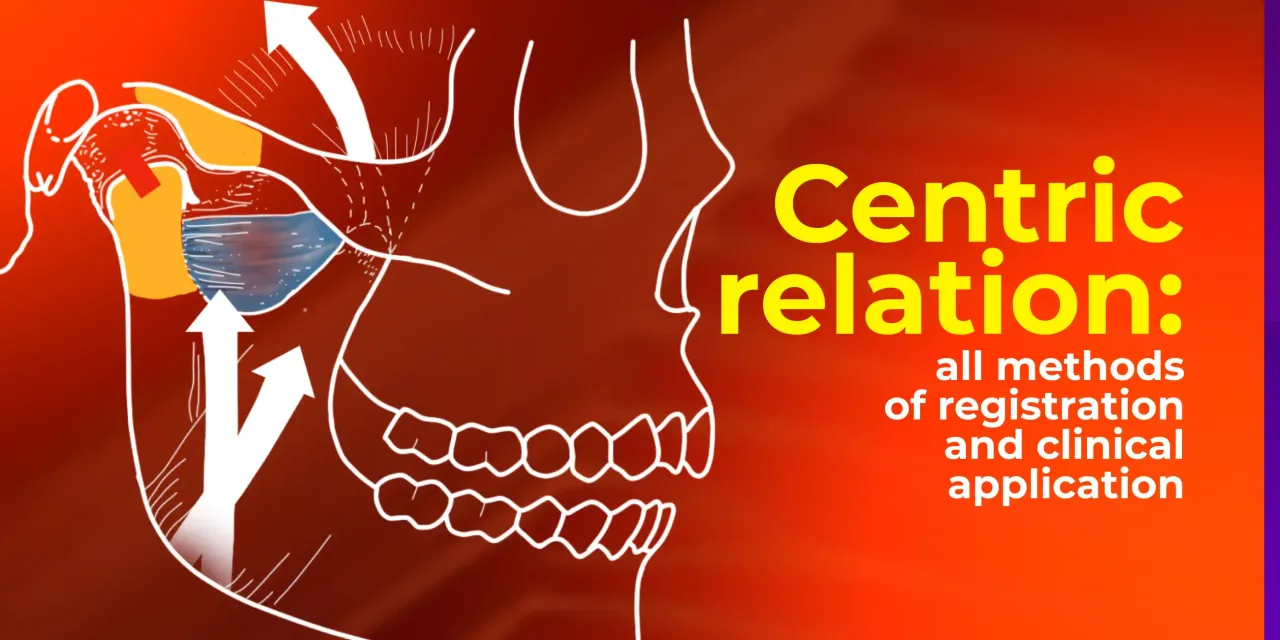
OHI-S Centric relation all methods of registration and clinical application
$80,00
This Product is shared via google drive download link, So please share your correct Gmail id while placing the order .Please note that there are no CME points or certificate associated with this course Samples for Courses Can be found here : Free Samples Here!
+ Include: 8 videos + 8 audios + 8 file sub vtt, size: 5.47 GB
+ Include: 8 videos + 8 audios + 8 file sub vtt, size: 5.47 GB
+ Target Audience: orthodontists, prosthodontists, functional dentists, dental technicians, general dentists
+ Information:
8 lessons (9h 15min)
Centric relation is the key to successful dental treatment!
We’ve put together EVERYTHING every dentist needs to know about the centric relation in one course where you’ll learn:
– All popular centric relation registration protocols: classical and digital
– Treatment planning taking into account the centric relation
– Centric relation in the work of an orthodontist and prosthodontist.
This course is required for all dentists involved in prosthetics, orthodontics and the treatment of tooth wear. After completing the training, you will be able to choose the optimal concept for CR registration!
The OHI‑S Centric Relation: All Methods of Registration and Clinical Application course is best for prosthodontists, restorative dentists, and general practitioners who want structured, training in occlusion and centric relation (CR) protocols. It emphasizes evidence‑based methods of recording CR, their clinical applications, and integration into restorative and prosthodontic treatment planning.
 Who Should Enroll
- Prosthodontists managing complex occlusal rehabilitation and full‑mouth restorative cases.
- Restorative dentists & general practitioners performing crowns, bridges, and veneers where CR registration is critical for long‑term stability.
- Orthodontists integrating CR into treatment planning for malocclusions and functional corrections.
- Residents & fellows in prosthodontics, restorative dentistry, or orthodontics seeking structured training in occlusion and CR techniques.
- Dental technicians collaborating on restorative workflows and understanding CR’s role in lab procedures.
 What You’ll Learn
- Centric relation fundamentals: definition, clinical importance, and role in occlusal stability.
- Methods of registration: bimanual manipulation, leaf gauge, Lucia jig, chin point guidance, and other techniques.
- Clinical application: how CR records guide restorative, prosthodontic, and orthodontic treatment planning.
- Diagnostic integration: using CR in articulator mounting and case analysis.
- Case‑based lessons: demonstrations of CR registration methods and their application in real patients.
+ Topics:
Lesson 1.Centric relation: introduction
– Centric Relation: modern definition
– Centric Relation: evolution of terminology
– Centric Occlusion: definition
– Vertical dimension of occlusion (VDO): definition
– Rule of thirds
– Mutually Protected Occlusion
– TMJ examination: clinical and laboratory
– Habit bite
– Centric Relation: clinical recommendations
– Chewing studies.
Recommended for: Orthodontists, Prosthodontists, Functional dentists, Dental technicians, General dentists.
Lesson 2.From the historical mechanic “centric relation” to a biological model
– The importance of CR in dentistry
– The modifications of the concept of centric relation (CR) over the years
– The problem and limitations of use CR for diagnosis and treatment
– Imaging and the jaw relationship
– Condyle position from a biological perspective
– TMJ pathology and its impact on occlusion
– Dental based vs orthopedic based occlusion.
Recommended for: Orthodontists, Prosthodontists, Functional dentists, Dental technicians, General dentists.
Lesson 3.CR registration using hard wax
– The terminal hinge axis movement concept
– Stable centric relation: definition
– P.K. Thomas and Lauritzen manipulation and the P. Dawson maneuver: disadvantages
– Method of registration of the centric relation using wax plates
– Creation of an anterior occlusal stop: indications and methodology
– Reproducibility of the central ratio: Split cast technique.
Recommended for: Orthodontist, Gnathologist, Prosthetist, Dental Technician, General Dentist.
Lesson 4.CR registration using neuromuscular approach. How to achieve stable results
– Occlusion and malocclusion: definition
– Rationale behind the neuromuscular approach to occlusion
– The concept of habitual bite
– Physiologic vs accommodative trajectory
– Available equipments used to diagnose and treat cases via neuromuscular approach
– Patient examination algorithm in the concept of neuromuscular dentistry
– CR registration using neuromuscular approach
– 3 keys to work in the concept of neuromuscular dentistry
– The method of obtaining the registry
– Orthotic: types and advantages of application
– Goals of the phase II of treatment
– What final options are available and an example of approaching a worn dentition rehabilitation
– Framework to approach occlusal stability.
Recommended for: Prosthodontists, Functional dentists, Restorers, General dentists.
Lesson 5.Dawson method of centric relation determination
– Centric Relation: definition and history
– Factors that affect Centric Relation records
– Central occlusion and maximal intercuspidation
– TMJ problems during orthodontic treatment
– Posselt diagram
– Occlusal diseases
– FACE Digital Mounting: principles
– Evaluation of Centric Relation term
– Centric Relation registration method: Dawson method and Lucia jig
– Preparation for orthodontic treatment
– Preparation for Centric Relation establishment: muscles deprogramming
– Mountings in Centric Relation
– Mistakes in Centric Relation determination.
Recommended for: Orthodontists, Prosthodontists, Functional dentists, Dental technicians, General dentists.
Lesson 6.Digital methods of centric relation determination
– The reliability of radiological methods for determining central occlusion
– Digital bite from IOS
– The concept of Tx: vertical control
– Centric Relation in case aligner treatment
– Prescription for technicians
– Aligners — save distalization appliance to hight-angle patients
– TMJ disk lock
– Pros and cons of digital treatment planning in arc of closure
– Hybrid treatment with Stop&Go: protocol
– Axioprisa: advantages of the technique
– Digital mounting protocols
– Surgery cases simulation.
Recommended for: Orthodontists, Prosthodontists, Functional dentists, Dental technicians, General dentists.
Lesson 7.Determining the CR using Lucia Jig
– Patient deprogramation
– Dawson Maneuver
– Placing the Lucia Jig: the technique, materials, typical mistakes
– Denar Wax or silicon bite registration: which method is better? Typical mistakes. Proper sequence of workflow
– Facebow
– Analogue models mounting in the articulator
– Models CR analysis.
Recommended for: Orthodontists, Prosthodontists, Functional dentists, Dental technicians, General dentists.
Lesson 8.Interdisciplinary treatment planning in the concept of centric relation
– Surgical cases in orthodontic treatment:
– transverse analysis
– suture maturity
– expantion
– Silesia Expander by Dr. Kamil.
– Digital assistent in dental office
– Molar torque correction
– Torque selection based on CBCT
– Assessment of long-term results of treatment.
Recommended for: Orthodontists, Prosthodontists, Functional dentists, Dental technicians, General dentists
Related products