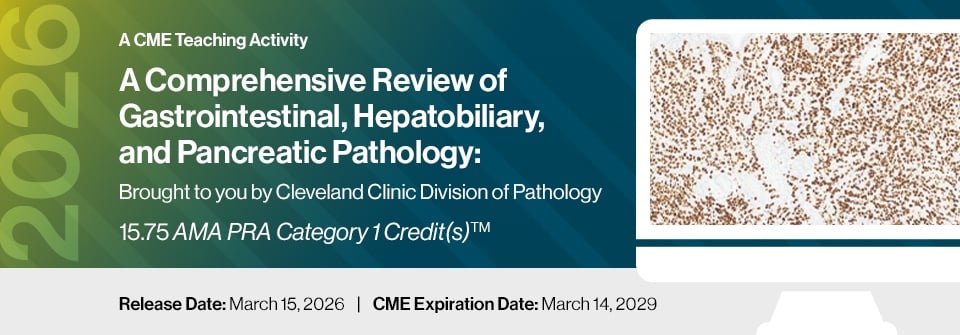
A Comprehensive Review of Gastrointestinal, Hepatobiliary, and Pancreatic Pathology Brought to you by Cleveland Clinic Division of Pathology 2026

19 videos,
Information:
- Released 03/15/26
This teaching activity has been designed to provide an extensive overview of some of the most common problem areas of diagnostic pathology in the area of gastrointestinal, hepatobiliary, and pancreatic pathology, with particular attention paid to the most common problems encountered by practicing pathologists. The course will provide extensive details of some of the most important diagnostic features which allow pathologists to make accurate diagnoses in each of these areas, as well as how to assess essential diagnostic clues and avoid the most common pitfalls. In each lecture, there is a discussion on the use of appropriate ancillary diagnostic techniques, including both immunohistochemistry and molecular pathology. Some of the lectures include case-based discussions including digital slides.
Target Audience
This teaching activity is primarily intended and designed to educate practicing pathologists.
Scientific Sponsor
Educational Symposia
Educational Objectives
At the completion of this teaching activity, you should be able to:
- Define the most common diagnostic pitfalls in diagnosing Barrett’s-related dysplasia
- Identify inflammatory patterns of the esophagus, particularly eosinophilic esophagitis
- Discuss the most common GI mesenchymal lesions encountered by practicing pathologists
- Identify the important features in both solid and cystic pancreatic lesions
- Recognize the most common neoplasms of the gallbladder and their mimics
- Define the pattern-based approach to non-inflammatory bowel disease colitis
- Describe the most important clinically relevant aspects to creating a pathology report for colorectal adenocarcinoma
- Review pancreatic ductal adenocarcinoma and inflammatory conditions which can mimic cancer
- Review the most important aspects of reporting biomarkers in gastrointestinal and pancreaticobiliary tumors
- Discuss the most common forms of gastritis and gastropathy seen in biopsy specimens
- Define the most common patterns and causes of injury associated with small bowel malabsorption
- Recognize the most common pitfalls in performing frozen sections of the gastrointestinal tract
- Describe the most recent updates in appendiceal neoplasia nomenclature
+ Topics:
- Barrett’s Esophagus and Barrett’s-Related Dysplasia – John R. Goldblum, M.D.
- Colorectal Adenocarcinoma: Essential Elements for Crafting a Clinically Relevant Pathology Report – Clifton Fulmer, M.D., Ph.D.
- Solid and Cystic Pancreatic Lesions: Challenges and Essential Reporting Guidelines – Ashwin S. Akki, MBBS, Ph.D.
- Gastritis and Gastropathy: Helicobacter Pylori and Beyond – Kenneth Friedman, M.D.
- The Morphological Spectrum and Mimics of Appendiceal Mucinous Neoplasia – Phoenix Bell, M.D., MSc
- GI Mesenchymal Tumors – John R. Goldblum, M.D.
- Pancreatic Ductal Adenocarcinoma and Inflammatory Mimics – Clifton Fulmer, M.D., Ph.D.
- Gallbladder Neoplasms and Their Mimics – Ashwin S. Akki, MBBS, Ph.D.
- Digital Slide Seminar: Esophageal Pathology – John R. Goldblum, M.D.
- Decoding Liver Metastases: A Pattern-Based Diagnostic Framework – Daniela Allende, M.D., MBA
- Challenges in Anal Pathology: A Case-by-Case Approach – Phoenix Bell, M.D., MSc
- IBD Dysplasia Demystified: Diagnostic Nuance and Clinical Relevance – Daniela Allende, M.D., MBA
- Biomarker Reporting in Gastrointestinal and Pancreatobiliary Cancers – Clifton Fulmer, M.D., Ph.D.
- Small Intestine Malabsorption: Making Sense of a Common Pattern of Injury – Kenneth Friedman, M.D.
- A Practical Guide to Diagnosing Steatotic Liver Disease – Daniela Allende, M.D., MBA
- Pattern-Based Approach to Non-IBD Colitis – Ashwin S. Akki, MBBS, Ph.D.
- Gastrointestinal Polyposis Syndromes & Associated Cancers – Phoenix Bell, M.D., MSc
- Frozen Section Pathology of the GI Tract: A Practical Review – Kenneth Friedman, M.D.
- Frozen Section Pathology of the GI Tract: A Practical Review (duplicate session) – Kenneth Friedman, M.D.