Skip to content
  • You can Pay crypto Get discount Contact US

  • You can Pay crypto Get discount Contact US

MeduStudentMeduStudent
  •                                                         
  • Login
  • Cart / $0.00 0
    • No products in the cart.

      Return to shop

  • 0
    Cart

    No products in the cart.

    Return to shop

  • Home
  • Shop
  • Category
    Anesthesiology
    Books
    Critical Care Emergency Medicine
    cardiology
    Dental
    Dermatology
    ENT
    Endocrine & Nutrition
    Family Medicine
    General Surgery
    GIT
    Hematology / Oncology
    Nephrology
    Internal Medicine
    Neurology
    Ophthalmology
    Obstetrics & Gynecology
    Plastic Surgery
    Orthopaedic
    surgery
    Respiratory / Pulmonary
    Radiology
    Rheumatology
    pediatrics
    Pathology
    psychology
    USMLE and Board Review
    Urology
  • About us
  • Contact us
Harvard Movement Disorders – Current Concepts And Practice 2023

Harvard Movement Disorders – Current Concepts And Practice 2023


  • Cleveland Clinic IBD Live 2022
  • EAN 2024 – 10th Congress Of The European Academy Of Neurology

$50.00

This Product is shared via google drive download link, So please share your correct Gmail id while placing the order .Please note that there are no CME points or certificate associated with this course Samples for Courses Can be found here : Free Samples Here!

Format :34 MP4 Files

File Size :5.71 GB

SKU: MED-AMB03083 Categories: Internal Medicine, Cardiology, Critical Care - Emergency medicine, Family medicine, Neurology, Rheumatology
  • Cleveland Clinic IBD Live 2022
  • EAN 2024 – 10th Congress Of The European Academy Of Neurology
Product categories
  • Anesthesiology & pain medicine
  • Books
    • Basic science
    • Cardiology books
    • FREE BOOKS
    • INTERNAL MEDICINE BOOKS
    • Neurology books
    • Obstetrics and gynecology books
    • Pathology books
    • Qbank & Questions
    • Radiology books
    • Surgery and surgical specialties
    • surgery books
    • Yoga and fitness
  • Cardiology
  • Critical Care - Emergency medicine
  • DENTAL
  • Dermatology
  • Endocrine and Nutrition
  • ENT / Otolaryngology
  • Family medicine
  • General Surgery
  • GIT COURSES
  • Hematology / Oncology
  • Internal Medicine
  • Medical Accounts
  • Nephrology
  • Neurology
  • Obstetrics & Gynecology
  • Ophthalmology & Optometry
  • Orthopaedic
  • Pathology
  • Pediatrics
  • physiotherapy
  • Plastic Surgery
  • psychology
  • Qbank & Questions
  • Radiology
  • Respiratory / Pulmonary
  • Rheumatology
  • Surgery
  • Uncategorized
  • Urology
  • USMLE / kaplan and Board Review
  • Description

Harvard Movement Disorders – Current Concepts And Practice 2023 (Videos Only)

Course Overview

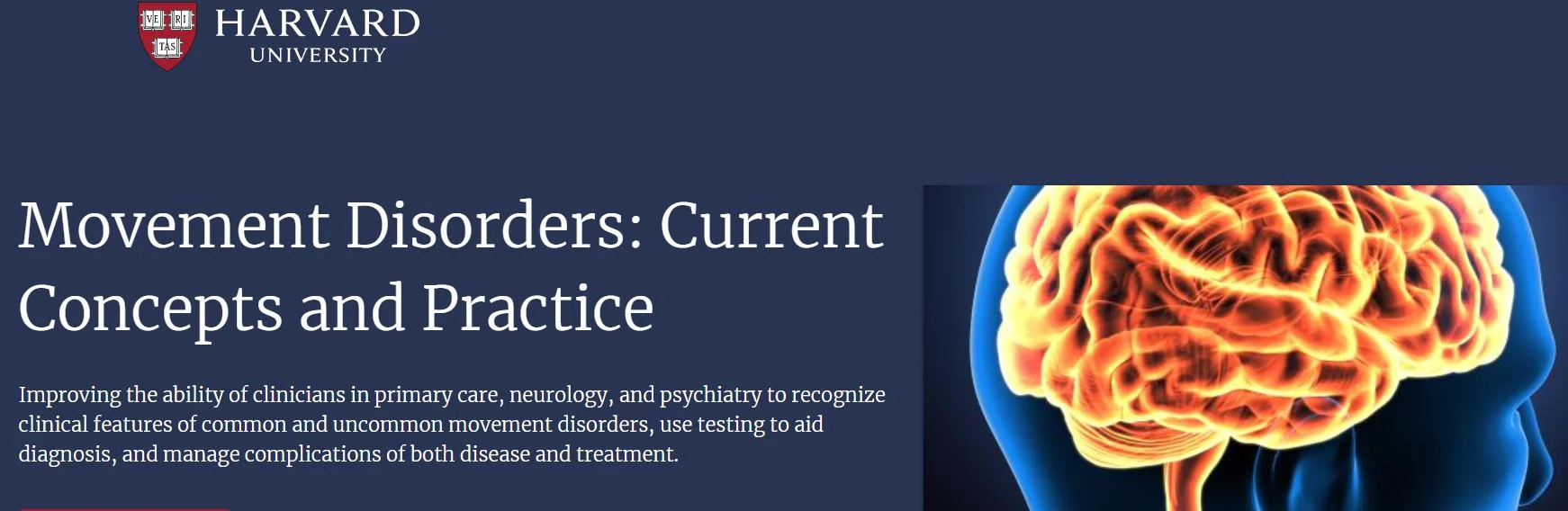
The goal of this course is to improve the ability of clinicians in primary care, neurology, and psychiatry to recognize clinical features of common and uncommon movement disorders, use testing to aid diagnosis, and manage complications of both disease and treatment. The evaluation and management of movement disorders depends upon targeted, historical assessment and physical examination of the patient. Conditions, such as essential tremor and Parkinson’s disease, are common and can produce significant disability and disease burden on patients and their caregivers.

Though Parkinson’s disease and essential tremor are two well-known disorders commonly encountered by the general practitioner and neurologist, a considerable percentage of cases are misdiagnosed. In addition, other highly treatable disorders, such as drug-induced movement disorders, dystonia, and tics can be difficult to recognize which can pose an obstacle to initiating proper treatment. There have been considerable advances in our understanding of certain complex movement disorders, such as Parkinson’s disease. We will also focus attention on non-motor aspects of Parkinson’s disease, which are increasingly being recognized as important determinants of quality of life.

The course will cover current concepts on pathophysiology of the various movement disorders, evidence-based evaluation and treatment recommendations, clinical practice guidelines as well as experience-based recommendations. Numerous patient videos will be shown throughout the presentations. Finally, the course will culminate with interactive discussion of video-based case examples.

Who Should Attend

  • Primary Care Physicians
  • Nurses
  • Nurse Practitioner
  • Other
  • Primary Care Practitioner
  • Pharmacists
  • Specialty Physicians,
  • Physician Assistant
  • Psychologists
  • Movement Disorder Fellows

Learning Objectives

Upon completion of this activity, participants will be able to:

  • Evaluate and diagnose movement disorders, such as Parkinson’s disease, Huntington’s disease, dystonia, tremor, myoclonus, tics, gait disturbances, chorea, tardive dyskinesia, and other disorders of
  • the basal ganglia, in different settings (emergency, inpatient, and outpatient).
  • Summarize treatment options and considerations in the management of movement disorders.
  • Recognize pitfalls in making an erroneous diagnosis in Parkinson’s disease, tremor or dystonia.
  • Describe the pharmacology and side effects of commonly used medications for treatment of various movement disorders.
  • Interpret the role of dopamine blockers in disease pathophysiology and management of tardive dyskinesia and drug-induced parkinsonism.
  • Integrate physical examination techniques into practice to aid in the diagnosis of a movement disorder.
  • Summarize diagnostic criteria and genetic counseling principles necessary for evaluating patients with suspected hereditary chorea or ataxia.
  • Explain a clinical evaluation method for gait disorders as well as diagnostic “red flags” that aid in the diagnosis of atypical parkinsonism.
  • Identify relevant components of the basic anatomy and pathophysiology of the basal ganglia as it pertains to movement disorders.
  • Assess potential therapeutic uses of botulinum toxin injections for dystonia, hemifacial spasm, and related disorders.
  • Discuss patient factors in the screening of candidates for deep brain stimulation.
  • Identify relevant issues regarding pre-operative evaluation and post-operative care for patients receiving deep brain stimulation.
  • Examine physical examination techniques and history taking skills in making the diagnosis of a psychogenic movement disorder.
  • Describe common non-motor aspects of Parkinson’s disease, including mood disorders and cognitive impairment, and summarize treatment options and best practices.

Related products

HIPPO Telemedicine: Common Conditions 2023
Quick View

Critical Care - Emergency medicine

HIPPO Telemedicine: Common Conditions 2023

$30.00
Hippo Family Medicine Bundle Adult and Peds 2023
Quick View

Family medicine

Hippo Family Medicine Bundle Adult and Peds 2023

$100.00
Hospital Medicine Review 2023
Quick View

Critical Care - Emergency medicine

Hospital Medicine Review 2023

$40.00
AccessMedicina (1-year Subscription)
Quick View

Medical Accounts

AccessMedicina (1-year Subscription)

$15.00
Medmastery 2021 (VIDEOS)
Quick View

Internal Medicine

Medmastery 2021 (VIDEOS)

$15.00
International Symposium on Intensive Care & Emergency Medicine ( ISICEM ) 2020
Quick View

Critical Care - Emergency medicine

International Symposium on Intensive Care & Emergency Medicine ( ISICEM ) 2020

$30.00
5-Minute Clinical Consult (5MCC) 1 Year subscription
Quick View

Medical Accounts

5-Minute Clinical Consult (5MCC) 1 Year subscription

$30.00
32nd ECCMID European Congress of Clinical Microbiology & Infectious Diseases
Quick View

Family medicine

32nd ECCMID European Congress of Clinical Microbiology & Infectious Diseases

$65.00
blank
Call us E-mail

My account

  • My orders
  • My Account
  • My Cart

Useful Links

  • Terms of Service
  • Privacy Policy
  • Refund Policy
  • Shipping Policy
  • FAQ

Contact

  • Telegram
  • Whatsapp
  • Mail
Visa
PayPal
Stripe
MasterCard
Cash On Delivery
Copyright 2026 © MeduStudent
  • Home
  • Shop
  • Category
  • About us
  • Contact us
  • Login
  • Newsletter

Login

Lost your password?

Register

Your personal data will be used to support your experience throughout this website, to manage access to your account, and for other purposes described in our privacy policy.