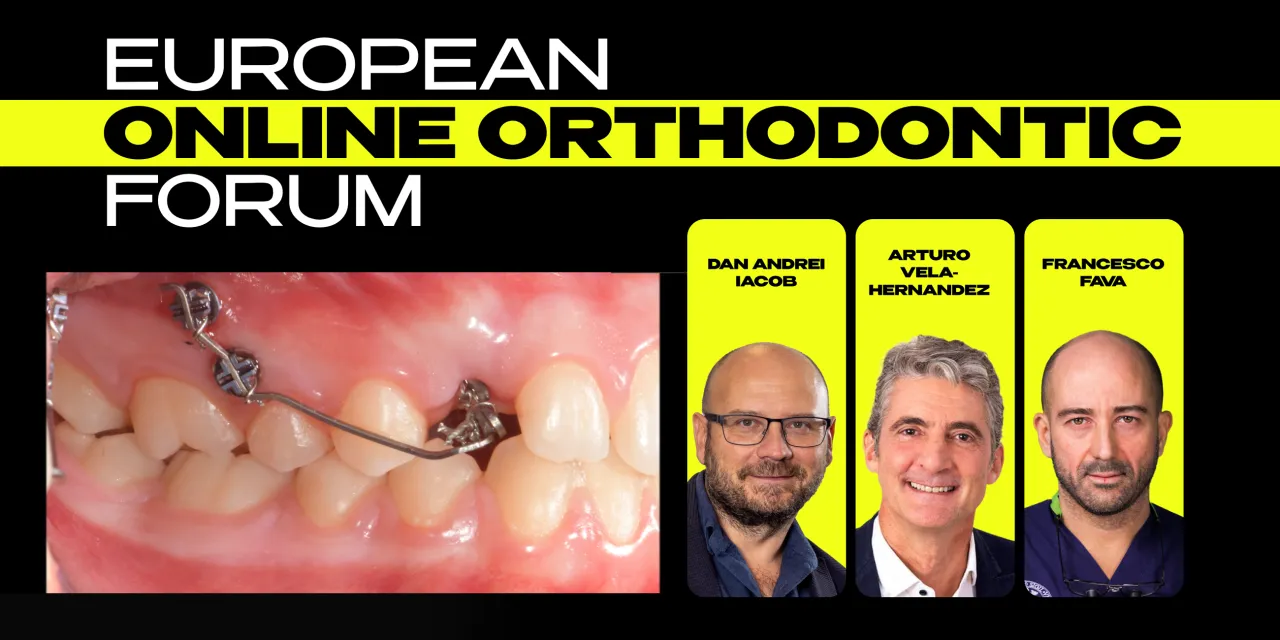
OHI-S European Online Orthodontic Forum. Advanced Protocols and Innovative Orthodontic Practices
$40,00
This Product is shared via google drive download link, So please share your correct Gmail id while placing the order .Please note that there are no CME points or certificate associated with this course Samples for Courses Can be found here : Free Samples Here!
Include: 6 videos + 6 audios + 6 file sub vtt, size: 3.16 GB
OHI-S European Online Orthodontic Forum. Advanced Protocols and Innovative Orthodontic Practices
Include: 6 videos + 6 audios + 6 file sub vtt, size: 3.16 GB
Target Audience: orthodontists, general dentists
Information:
6 lessons (5h 28min)
Advanced protocols and innovative practices in orthodontics are featured in the online version of the European Orthodontic Forum, where high treatment standards meet high expertise!
During the course, you will explore the most relevant topics in modern orthodontics:
– Biomechanics of orthodontic treatment
– Aligner therapy for open bite
– Aligners + skeletal anchorage
– Orthodontic treatment of patients with TMD
– Use of cantilevers for the treatment of canine impaction.
You will enjoy lectures from outstanding specialists who share only clinical, experience-based content — practical insights, real cases, and evidence-based approaches that can be directly applied in your daily orthodontic practice.
The OHI‑S European Online Orthodontic Forum: Advanced Protocols and Innovative Orthodontic Practices is best for orthodontists, dentists, and allied professionals who want CE‑accredited training in cutting‑edge orthodontic techniques, interdisciplinary workflows, and evidence‑based protocols. It is designed as a high‑level forum to share innovations and advanced practices across Europe and internationally.
👩⚕️ Who Should Attend
- Orthodontists seeking to update their knowledge with advanced protocols and innovative treatment strategies.
- General dentists who integrate orthodontics into comprehensive care plans.
- Prosthodontists & restorative dentists collaborating on interdisciplinary cases involving orthodontic alignment.
- Oral & maxillofacial surgeons coordinating surgical orthodontic cases with functional and aesthetic outcomes.
- Dental technicians supporting orthodontic workflows with digital and lab‑based innovations.
- Residents, fellows, and trainees in orthodontics or restorative dentistry gaining exposure to international best practices.
📚 What You’ll Learn
- Advanced orthodontic protocols: modern biomechanics, aligner therapy, and interdisciplinary case management.
- Innovative practices: digital workflows, AI‑assisted planning, and minimally invasive orthodontics.
- Functional integration: occlusion, airway, and musculoskeletal considerations in orthodontic treatment.
- Aesthetic optimization: smile design and facial harmony in orthodontic planning.
- Case‑based lessons: real patient examples demonstrating predictable outcomes.
- International perspectives: insights from European experts on evolving orthodontic standards.
Topics:
Lesson 1.Principles and Biomechanics of Open Bite Treatment with Aligners
– Advantages of treating open bites with aligners as opposed to conventional fixed appliances
– Misconceptions in the planning of open bite treatment with aligners
– Basic biomechanical resources
– The different planning strategies based on scientific evidence
– Evidence-based biomechanical concepts
– Typical errors in open bite diagnosis and treatment planning.
Recommended for: Orthodontists, General dentists.
Lesson 2.Advanced Planning and Treatment Protocols for Open Bite with Aligners and TADs
– Evidence-driven approaches to open bite correction
– Sequencing of tooth movements for optimal results
– How to handle auxiliary resources in severe cases
– Treatment protocols for complex cases with aligners and skeletal anchorage devices
– Analysis of clinical cases.
Recommended for: Orthodontists, General dentists.
Lesson 3.Orthodontic Treatment of Patients with TMD
– Principles of orthodontic treatment for patients with TMJ dysfunctions
– Analysis of the TMJ and biomechanical movement of the lower jaw
– Introduction to splint therapy in the orthodontic context
– Biomechanics of orthodontic treatment for patients with TMJ dysfunctions.
Recommended for: Orthodontists, General dentists.
Lesson 4.Splint Therapy and Clinical Applications for Orthodontic Patients
– When and why splint therapy is indicated
– Integration with orthodontic treatment
– Types of splints:
– Occlusal splints: stabilization, repositioning, and functional
– Selection criteria based on patient presentation.
– Clinical application:
– Combining splint therapy with orthodontic biomechanics
– Monitoring patient progress and adjusting treatment.
Recommended for: Orthodontists, General dentists.
Lesson 5.Cantilevers: Key to Success in Canine Impaction Management
– Overview of impacted canines and their clinical challenges
– The clinical advantages and the potential of cantilevers
– Why are cantilevers for impacted canines more efficient and effective than elastic tractions.
Recommended for: Orthodontists, General dentists.
Lesson 6.Clinical Protocols and Case Applications of Cantilevers
– When to use cantilevers in clinical practice
– Basic principles of cantilever mechanics
– Step-by-step bending techniques for clinical use
– Avoiding common biomechanical errors
– Analysis of clinical cases.
Recommended for: Orthodontists, General dentists.
Related products


Plastic Surgery