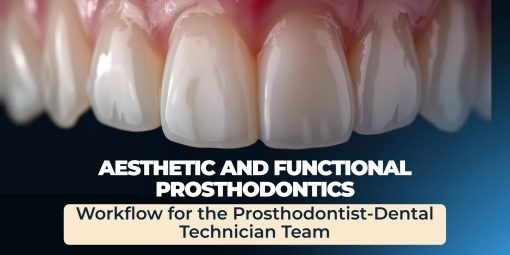
OHI-S Aesthetic and Functional Prosthodontics. Workflow for the Prosthodontist-Dental Technician Team
Include: 4 videos + 4 audios + 4 file sub vtt, size: 3.02 GB
Target Audience: prosthodontists, dental technicians, general dentists
Information:
4 lessons (5h 4min)
Analog and digital protocols for aesthetic and functional indirect restorations and removable dentures, presented in collaboration with the world’s leading prosthodontists and dental technicians!
Join Oliver Brix, and Jürgen Wahlmann on a journey to master aesthetics and mimic nature in dental treatments.
During the course, you will learn about:
– Aesthetic and functional aspects of removable dentures
– The future of ceramics: analog vs. digital methods for working with ceramics
– Aesthetic smile: a team approach to creation
– Managing complex clinical cases: functional and aesthetic rehabilitation through a team approach.
The OHI‑S Aesthetic and Functional Prosthodontics: Workflow for the Prosthodontist–Dental Technician Team course is best for prosthodontists, general dentists, and dental technicians who want structured, CE‑accredited training in collaborative workflows for functional and aesthetic prosthodontic restorations. It emphasizes teamwork between clinician and technician to achieve predictable, high‑quality outcomes.
Who Should Enroll
- Prosthodontists managing complex restorative and full‑mouth rehabilitation cases.
- General dentists performing aesthetic and functional prosthodontic treatments who want to strengthen lab collaboration.
- Dental technicians & lab professionals fabricating veneers, crowns, bridges, and implant prosthetics with precision.
- Residents, fellows, and trainees in prosthodontics or restorative dentistry seeking structured interdisciplinary training.
- Implantologists & oral surgeons coordinating surgical and prosthetic planning with lab teams.
What You’ll Learn
- Collaborative workflow protocols: step‑by‑step communication between prosthodontist and dental technician.
- Functional design principles: occlusion, load distribution, and long‑term stability of restorations.
- Aesthetic optimization: smile design, gingival harmony, and natural tooth replication.
- Digital & analog integration: CAD/CAM workflows combined with traditional craftsmanship.
- Case‑based lessons: real patient examples demonstrating teamwork for predictable results.
Topics:
Lesson 1.Solving complex functional and aesthetic cases – a new team approach to success
– Importance of the NHP (natural head position)
– Plane System by Udo Plaster
– Phonetic bite registration
– Influence of face asymmetries on treatment planning
– Proper dentist/lab communication as a key for success
– Analog vs. Digital, Layered vs. CAD/CAM
– Testing the new functional and aesthetic situation: how and when
– Step by step approach for a predictable result even in complex functional and/or aesthetic cases
– Q&A session.
Recommended for: Prosthodontists, Dental technicians, General dentists.
Lesson 2.Full-Mouth Rehabilitation: Profound Functional and Systematic Approach
– Functional diagnosis prior to full-mouth cases
– Mouth-body connection in full-mouth rehabilitation cases
– Protocols of phonetic bite registration
– Profound systematic approach
– Step-by-step wax-up protocols
– Aesthetic and functional considerations and solutions
– Analysis of clinical cases
– Q&A session.
Recommended for: Prosthodontists, Dental technicians, General dentists.
Lesson 3.Mastering Aesthetic Restorations: A Collaborative Approach to Excellence
– Patient-dentist-technician communication and its importance in achieving aesthetic results
– Understanding functional and structural anatomy and its analysis
– Application of the facebow and mounting on the articulator
– Natural construction of restorations: layering vs. milling
– Colorimetry in aesthetic dentistry.
Recommended for: Prosthodontists, Dental technicians, General dentists.
Lesson 4.Analog vs. Digital Indirect Restorations
– Material selection by dental technicians
– Analog vs. digital indirect restorations
– Protocols for manufacturing veneers on refractory dies
– Step-by-step layering protocols for ceramic aesthetic restorations
– Where analog techniques should be used and where digital workflows should be applied
– Aesthetic and functional considerations and solutions.