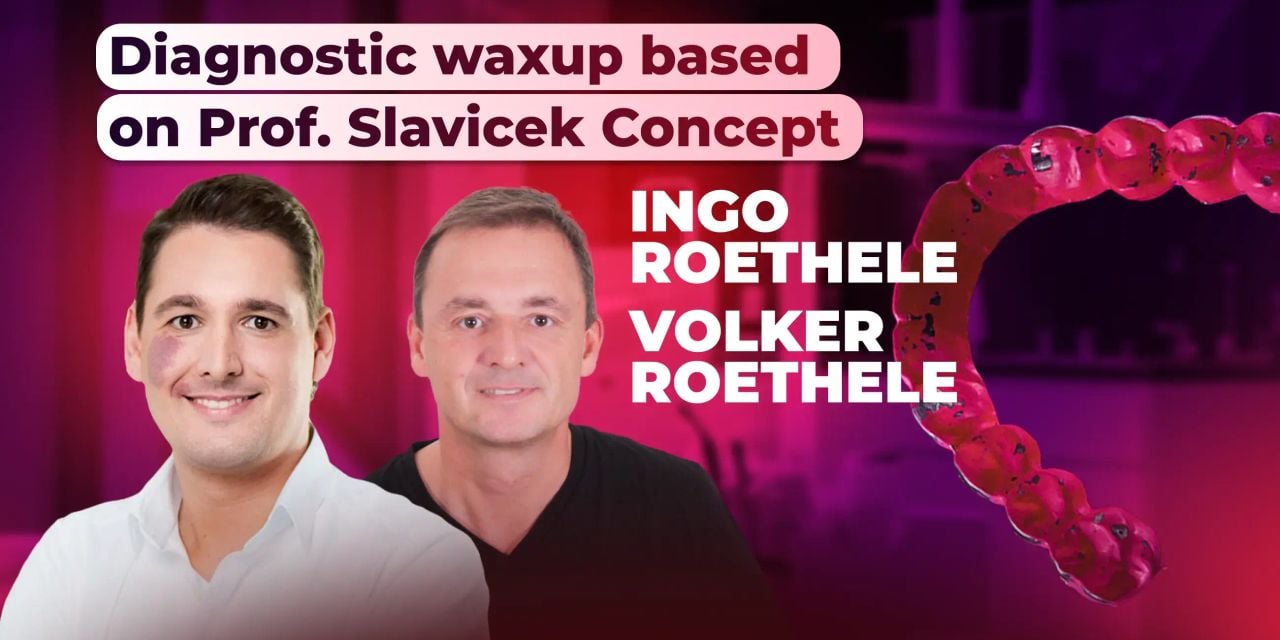
Diagnostic waxup based on Prof. Slavicek concept

$30.00
This Product is shared via google drive download link, So please share your correct Gmail id while placing the order .Please note that there are no CME points or certificate associated with this course Samples for Courses Can be found here : Free Samples Here!
Diagnostic waxup based on Prof. Slavicek concept
+ Include: 10 videos, size: 6.64 GB
+ Target Audience: prosthodontists, functional dentists, dental technicians
+ Information:
10 lessons (18h 28min)
An online course on diagnostic wax up based on Professor Rudolf Slavichek concept.
From the course you will learn:
- – The principles of the concept of a sequential guide
- – Protocol of wax up of class I based on Professor Slavichek concept (analog method)️
- – Protocol of work in EXOCAD: articulator settings and wax up
- – Protocol of wax up of the posterior part of the occlusal plane
- – Protocol of waxing the sequential guidance (F2) and aesthetic points on the lateral teeth️
- – Methods of modeling of the upper and lower front teeth
- – Cross bite modeling protocol.
Thanks to the format of the video demonstration, you will be able to repeat all the steps yourself and comprehend the materials better.
Who is this course actually for?
-
Dental Technicians: This is arguably the primary audience. Technicians who need to physically (analog) or digitally (using EXOCAD) model complex occlusions, set up articulators, and build precise wax-ups.
-
Functional Dentists & Gnathologists: Dentists treating temporomandibular joint (TMJ) disorders, severe bruxism, or complex bite issues who need a deep understanding of functional morphology.
-
Prosthodontists: Specialists handling full-mouth rehabilitations who rely on the Vienna School of Interdisciplinary Dentistry (VieSID) principles to ensure their reconstructions do not damage the patient’s jaw joints.
Course Overview (18h 28m / 10 lessons)
This specific curriculum focuses heavily on translating theoretical gnathology into practical, step-by-step benchwork. Key topics generally include:
-
The Slavicek Concept: Understanding sequential guidance and the functional parameters of the stomatognathic system.
-
Analog & Digital Workflows: Protocols for traditional wax-ups as well as digital modeling using EXOCAD software.
-
Step-by-Step Modeling: Detailed techniques for waxing up Class I occlusions, posterior occlusal planes, and modeling both upper and lower front teeth.
-
Complex Scenarios: Protocols for managing crossbite modeling and establishing aesthetic reference points.
Because this course is incredibly technical and heavily focused on biomechanics and software (like EXOCAD), it requires a strong foundational knowledge of dental anatomy.
+ Topics:
Lesson 1.Digital documentation and dental photography
- – The value of dental photography
- – Basic principles of photography
- – Options for saving photos on the camera: RAW, JPG, TIF
- – Camera Settings:
- – Light Sensitivity (ISO)
- – Aperture
- – Shutter speed
- – Programmable modes.
- – Lighting: main light sources
- – Analytical photos
- – Tools for dental photography
- – Color communication of dental photography
- – Photographing models: tips
- – Archiving images.
Recommended for: Prosthodontists, Functional dentists, Dental technicians.
Lesson 2.The basic principles of Slavicek Concept and Theory and How to Adapt to
- – Plastering of models in the articulator
- – Cases of impaired function: principles of treatment in the concept of Slavichek
- – Production of single crowns: planning and analysis of plaster models
- – Clinical and functional analysis of the patient
- – Bruxchecker as a diagnostic tool
- – Basic concepts of the Slavichek concept:
- – Laterotrusia and mediotrusia
- – Retroactive control
- – Protrusive control
- – Occlusal plane
- – Saggital articular tilt
- – Transversal articular tilt
- – Direct lateral shift.
- – Definition of the hinge axis
- – Reference position and therapeutic position of the joint: differences
- – Calculation of disocclusion angle: a mathematical and theoretical approach
- – The concept of a sequential guide
- – Key aspects of occlusion
- – Overview of occlusal splints.
Recommended for: Prosthodontists, Functional dentists, Dental technicians.
Lesson 3.Wax-up class 1 based on prof. Slavicek concept (analog)
- – Getting accurate impressions
- – Protrusion control and protrusive guide according to Class 1
- – Components of the Slavichek concept
- – The value and calculation of disocclusion angle
- – Basic principles of morphology of Class 1
- – Evaluation of condylography data
- – Working in the Gammadental program
- – Principles of working with the articulator
- – The concept of the inter-coronal space
- – Principles of wax modeling
- – Modeling of active and passive centric
- – Analysis of plaster models.
Recommended for: Prosthodontists, Functional dentists, Dental technicians.
Lesson 4.Wax-up of so-called malocclusions (analog)
- – Basic principles of morphology
- – The main compensatory mechanisms
- – Splint therapy: indications, design, manufacture
- – Milled or printed splint: advantages
- – The principle of operation of the variator
- – Wax modeling of class 2
- – Step-by-step modeling procedure
- – Definition and modeling of a group guide
- – Options for reducing of the occlusal plane angle
- – Management of complex clinical cases:
- – a patient with worn dentition
- – a patient with a crossbite.
Recommended for: Prosthodontists, Functional dentists, Dental technicians.
Lesson 5.The concept of pr. Slavicek in digital dentistry
- – Diagnostics and analysis of plaster models
- – Communication tools of a dentist and a dental technician: advantages of digital dentistry
- – Step-by-step protocol of working in Cadias 3D:
- – Scanning of plaster models
- – Data import
- – Segmentation of teeth
- – Digitization mode
- – Occlusive protocol
- – Documentation.
- – EXOCAD: articulator settings and wax up
- – Digital production of temporary prosthetics.
Recommended for: Prosthodontists, Functional dentists, Dental technicians.
Lesson 6.Case and cast analysis
- – Programming and settings of the articulator for the first stage of analog modeling
- – The basic principles of class 1
- – Stages of modeling:
- – Wax up of the anterior part of the occlusal plane
- – Wax up of the posterior part of the occlusal plane
- – Modeling of active centric
- – Formation of the Spee curve
- – Modeling of passive centric.
Recommended for: Prosthodontists, Functional dentists, Dental technicians.
Lesson 7.Waxing the sequential guidance (F2) and the esthetic points on lateral teeth
- – Modeling protocol: from anterior to posterior
- – The value of the preliminary setting of the articulator
- – Formation of the Wilson curve
- – Determination of the position and modeling of the active centric of the upper jaw
- – Functional aspects of the position of the active and passive centric
- – Wax up of class 2
- – Modeling of functional points on molars and premolars (F1 and F2)
- – Using protrusion clips
- – Modeling of the functional path
- – Advantages of the sequential separation concept
- – Wax up of the aesthetic surface of the upper and lower jaw.
Recommended for: Prosthodontists, Functional dentists, Dental technicians.
Lesson 8.Finishing wax-up of upper and lower molars
- – Formation of media intrusive paths
- – Modeling of the lingual surface of molars
- – Modeling of the passive centric on the buccal side
- – Settings of the individual incisor table
- – Creating a passive centric on premolars
- – Aesthetic modeling of the lingual surface of molars.
Recommended for: Prosthodontists, Functional dentists, Dental technicians.
Lesson 9.Finishing premolars and retrusivе control
- – Protrusive and retrusive elements
- – Creating a retroactive control on the premolar
- – Assessment of the quality of the simulated roller
- – Wax modeling of protrusion
- – Application of protrusion clips
- – Modeling F1 and F2 on the central incisors
- – The difference between individual and sequential incisor table
- – Function point F3: position and value.
Recommended for: Prosthodontists, Functional dentists, Dental technicians.
Lesson 10.Finishing wax-up of front teeth
- – Modeling of the occlusal surface
- – Determination of the position of the occlusal contact on the tooth
- – Ways to strengthen wax cones
- – Modeling of the front teeth of the upper and lower jaw
- – Modeling of crossbite
- – Basic functional parameters
- – Completion of the modeling: protrusive control.
Recommended for: Prosthodontists, Functional dentists, Dental technicians.
Related products